
We started as usual at Montauk Point State Park, scoping the ocean from the overlook behind the restaurant. Despite the poor viewing conditions, we managed to see most of the species typically present near shore at this time of year. We saw over 60 Razorbills, including a couple of flyby flocks containing >10 birds, as well as smaller groups and singles sitting on the water. Also seen were all 3 scoter species, Common Eider, Long-tailed Duck, Red-breasted Merganser, Common Goldeneye, Common and Red-throated loons, a few Northern Gannets, and a single Great Cormorant. All were present in lower numbers than we’re used to seeing, unless there were throngs of them farther offshore out of sight behind the fog bank.
Working our way back west, we headed down East Lake Drive to Outer Beach on the east side of Montauk Harbor inlet. There, among the gulls loafing on the pebbled beach just south of the jetty, were two adult Iceland Gulls, a species somewhat regularly encountered at this location, but always an enjoyable discovery. Our next stop was the beach at the end of South Lake Drive. Other than a flock of Common Goldeneye, water birds were scarce. Thankfully there was some land bird activity in the thickets up the road. It took a fair amount of ‘pishing’, but we managed to see or hear Winter Wren, Gray Catbird, Field and Swamp sparrows, and Yellow-rumped Warbler. After a scrubbed visit to Ditch Plains (tide and surf high, fog), we visited Ice House Pond and Fort Pond Bay, where we added Ring-necked Duck and Horned Grebe respectively.
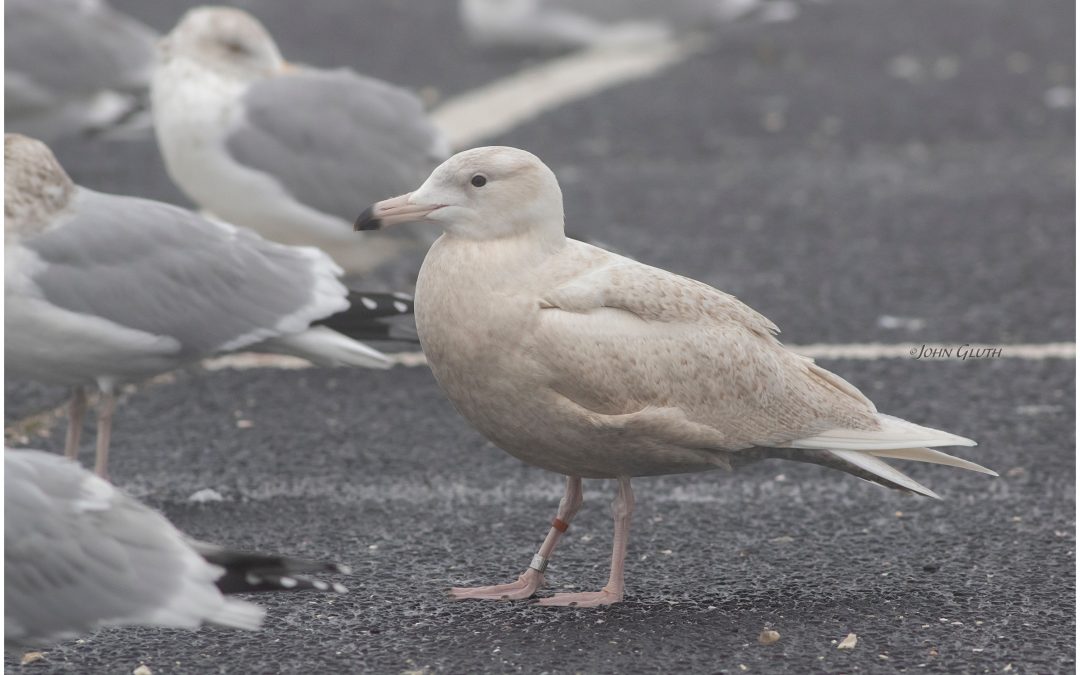
After a brief and unrewarding visit to Kirk Park, we departed Montauk. We made a slow drive down Napeague Meadow on our way west, but failed to turn up anything notable there. We skipped our usual stop at Hook Pond due to the fog and instead went straight to Shinnecock Inlet. There the thick mist again hampered our efforts, making a Harlequin Duck that had been reported recently undetectable. Luckily one of our group had lagged behind our caravan and popped into the parking lot at Ponquogue Beach, where he found a juvenile Glaucous Gull, easily the bird of the trip. We wrapped up with a slow cruise west along Dune Road. Three Northern Harriers visible at once hunting over the salt marsh at Hot Dog Beach was the highlight. This field trip, our first annually, is always much anticipated, both as an opportunity to see many species the first time for the year and as a chance to see some harder to find species. Despite the tough weather conditions, this year’s trip delivered on both accounts.